

Lego Com Mindstorms Software Mission 01
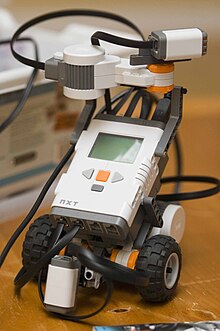 Robot based on the NXT platform | |
| Subject area | Robotics |
|---|---|
| Availability | one September 1998 (1998-09-01)– |
| Official website | |
Lego Mindstorms is a hardware and software structure which develops programmable robots based on Lego building blocks. Each version includes computer Lego bricks, a set of modular sensors and motors, and Lego parts from the Technic line to create the mechanical systems. The organization is controlled by the Lego bricks.
While originally conceptualized and launched as a tool for supporting educational constructivism, Mindstorms has get the starting time home robotics kit available to a wide audience. It has developed a customs of adult hobbyists and hackers following the product's launch in 1998.
Pre-Mindstorms [edit]
Background [edit]
In 1985, Seymour Papert, Mitchel Resnick and Stephen Ocko created a company called Microworlds with the intent of developing a construction kit that could exist blithe by computers for educational purposes.[1] : 14 Papert had previously created the Logo programming language as a tool to "support the development of new ways of thinking and learning",[2] : 14 and employed "Turtle" robots to physically human action out the programs in the real world.[two] : 55–56 As the types of programs created were limited by the shape of the Turtle, the idea came up to make a construction kit that could use Logo commands to animate a creation of the learner's ain design.[3] : 3 Similar to the "flooring turtle" robots used to demonstrate Logo commands in the real world, a construction system that ran Logo commands would also demonstrate them in the real earth, but allowing the kid to construct their own creations benefitted the learning experience past putting them in command [4] In considering which construction system to partner with, they wanted a "low flooring loftier ceiling" approach, something that was easy to pick up merely very powerful. To this end, they decided to use LEGO bricks due to the system and diversity of pieces, and the Logo language due to the groups familiarity with the software and its ease of use.[1] : 14 LEGO was receptive to collaboration, specially because its educational sectionalisation had founding goals very similar to those of the Microworlds company. The collaboration very quickly moved to the newly minted MIT Media lab, where there was an open sharing of ideas.[1] : 14 As a sponsor of the entire lab, LEGO was allowed royalty free rights to mass-produce any applied science produced by Papert, Resnick and Ocko's group; and was also allowed to send an employee over to aid with research, so they sent engineer Alan Tofte (also spelled Toft) who helped with the design of the programmable brick.[ane] : 35 [five] : 74 As another part of the MIT Media Lab was community outreach, then the bricks would be used working with children in schools for both research and educational purposes.
LEGO/Logo, lego tc Logo (1985) [edit]
The first experiments of combining LEGO and the Logo programming language was chosen LEGO/Logo and it started in 1985.[4] Similar to the "floor turtles" used to demonstrate Logo commands in the real world, LEGO/Logo used Logo commands to animate Lego creations. Information technology is important that children could build their own machines to programme, as they would then intendance more than well-nigh their projects and be more willing to explore the mathematical concepts involved in making them move. The LEGO/Logo arrangement allowed children to create their ain designs and experiments, offered multiple paths for learning and encouraged a sense of community. Starting time, machines are built out LEGO. The machines are and then connected to a computer and programmed in a modified version of Logo. The LEGO/Logo system introduced new types of parts for making creations such equally: motors, sensors and lights. The motors and sensors are connected to an interface box which is communicates with a computer.[4] LEGO/Logo would later be commercialized past the LEGO group LEGO tc Logo.[3] : 3 It was observed that using the LEGO/Logo organisation, children adult a class of noesis about the physical world that allowed those fifty-fifty without mathematics or verbal skills to solve problems effectively using the system.[5] : 23
Logo Brick 1st Generation, "Grey Brick" (1986) [edit]
While LEGO/Logo was powerful, it was restricted somewhat by the requirement to have the creations attached to a figurer.[iii] : 3 The grouping began working on further iterations of the LEGO/ LOGO environment to produce a robot that could collaborate not simply with the surroundings but with other robots programmed in the same system.[five] : 24 The experiments with an untethered brick (called the Logo Brick or "Grey Brick") began in the fall of 1986. To speed upwardly the design process, the Logo Brick contained the processor chip from an Apple II estimator. It ran an adapted version of LEGO/Logo written for the Apple II computer.[5] : 74 The LEGO/Logo interface box, The previous development of the group, had just two sensor ports available, which the design team observed were not always enough. To address this, they gave the Logo Brick four sensor ports. The Logo Brick was made out of a modified LEGO bombardment box and was nearly the size of a deck of cards.[5] : 74, 23 The Logo Brick was tested in schools.
LEGO Mindstorms and RCX (1996) [edit]
Evolution [edit]
While LEGO had been interested in mass-producing the programmable brick concept for a while, they had to wait until plenty people owned personal computers and the components required to produce the intelligent brick went downwardly in price.[1] : 25 Development of what would later be known as LEGO Mindstorms started in 1996 as the offset product of the newly created home-learning division of LEGO Education (LEGO Dacta). The product'south name of "Mindstorms" was intended to express the user experience of the production, information technology is named after Papert'southward book Mindstorms, as the user experience was similar to the educational constructivism concepts described in his book.[6] The LEGO habitation education team used the insights that MIT researchers discovered from testing the 3rd Generation Logo Brick ("Red Brick") in schools as the footing for the development of the mass-produced programmable brick.[three] : 5 The physical programmable brick was re-engineered from the basis up, every bit the experimental programmable bricks were non designed for robustness or toll-effective manufacturing.[1] : 19, 26 The programming language of the product was developed with help from members of the MIT Media lab. LEGO decided to use a Visual programming linguistic communication for Mindstorms, inspired by the LOGOBlocks language previously used with programmable brick experiments, in order to brand the product attainable to children who might be unfamiliar with programming.[1] : 29 While the technology that Mindstorms was based on was aimed towards "all children", the chosen target demographic of LEGO Mindstorms was intentionally narrow, in order to garner positive press by outselling expectations. The conclusion was made to aim the production towards 10 to xiv-year-old boys, partially because it was LEGO's staff of life-and-butter demographic, and partially based on market place research (not substantiated by the findings of the MIT Media Lab) which ended that this demographic would exist almost attracted to computerized toys. This pick of target demographic straight informed the color of the RCX brick (which was made yellow and black to resemble construction equipment) and the sample uses for the Mindstorms kit (such as making democratic robots).[1] : 28
The projection's at-first low profile immune the Mindstorms team the freedom to develop the production using operating procedures so-unorthodox to the LEGO Grouping.[7] : 1062 Unlike traditional LEGO sets, the Mindstorms Robotics Invention System did not have a master model, nor was the play driven past storytelling.[ citation needed ] To bridge the gap between this new play experience and pre-existing LEGO ones, the Mindstorms team created a lot of opportunities for people interested in the product to engage with each other, such equally the creation of Mindstorms.com, Mindstorms Discovery Centers, and the Get-go Lego League.[6] The cosmos of these experiences was done through partnerships with a relatively large amount of external groups that the Mindstorms team interacted with as equal partners, something that was uncommon for the LEGO grouping at the time.[7] : 1063 To ease tensions between Mindstorms and more conventional products, the project team was given autonomy from LEGO's product development process and instead reported direct to the company's senior direction.[vii] : 1064
Promotion of the LEGO Mindstorms Robotics Invention Arrangement began 6 months before the production was planned to launch.[half-dozen] The product was first soft launched with the opening of the Mindstorms Discovery Centre at the Museum of Science and Industry, where children could interact with the Mindstorms Robotics Invention Organisation to complete set tasks, getting them familiar with the product.[8] The Mindstorms product was launched meantime with LEGO Cybermaster, another LEGO product spun off from the MIT programmable brick technology that was more in line with the traditional product philosophies of the LEGO group.[7] : 1067
Instead of beingness sold at toy stores, the product was sold at electronics stores similar BestBuy and CompUSA, due to the relatively loftier cost of the set up.[6]
Launch [edit]
LEGO Mindstorms was released on 1 September 1998[nine] at a retail price of $199. The entire production run (of between 60-100 m units[10]) sold out within 3 months.[11] : 181 [i] : xxx Despite existence aimed towards children, the kit quickly plant an audition with adults and hackers of all ages; Lego company surveys had determined that seventy per centum of Lego Mindstorms Hobbyists were adults. Soon post-obit the product's launch, hobbyists began sharing reverse-engineered versions of the RCX brick's Microcode and Firmware on the internet, leading to the evolution of alternative programming languages for the RXC such as "Not Quite C" (NQC) and alternative operating systems for the brick like legOS. The Lego Grouping was surprised by the products embrace by adult hobbyists, and was not sure how to respond to the sharing of proprietary lawmaking. The Mindstorms team would determine that the embrace of the product past the hacking customs proved that the product was worth developing; In society to foster this burgeoning community, an official forum was established on the Lego website and a "right to hack" clause was added to terminate user license understanding of the Lego Mindstorms software.[11] : 181–184
Robotics Discovery Set and Droid/Darkside Developer Kit [edit]
The Robotics Discovery Fix was a more affordable and simpler package than the Robotics Invention Set. Instead of being based on the RCX, it had its own programmable brick called the Scout. An fifty-fifty simpler version of the Scout would be featured in ii Star-Wars-themed Mindstorm sets besides.
Scout [edit]
Lego also released a blue figurer called the Scout, which has ii sensor ports, 2 motor ports (plus i extra if linked with a Micro Scout using a fiber optic cablevision), and a built-in calorie-free sensor, but no PC interface. It comes with the Robotics Discovery Set up. The Scout tin can be programmed from a collection of built-in programme combinations. In order to program the Scout, a user must enable "power mode" on information technology. The Scout can store one program.
The Lookout man is based on a Toshiba microcontroller with 32 KB of ROM and 1 KB of RAM, where most 400 bytes are available for user programs. Due to the extremely limited amount of RAM, many predefined subroutines were provided in ROM. The Scout simply supports passive external sensors, which means that only touch, temperature and other unpowered sensors can be used. The analog-to-digital converters used in the Scout just have a resolution of 8 $.25, in dissimilarity to the ten-scrap converters of the RCX.[12]
There was a plan for Lego to create a booster set up that allows yous to program the Scout from a reckoner with software such as RCX lawmaking. Withal, due to the complexity of this project, it was abandoned.
The RCX tin control the Lookout man brick using the "Ship IR Message" plan cake. The RCX does all of the controlling, and therefore can exist programmed with the PC, while the Picket accepts commands. The Scout brick must accept all of its options set to "off" during this process.
Micro Scout [edit]
The Micro Scout was added every bit an entry-level to Lego robotics. Information technology is a very express Pbrick with a single congenital-in light sensor and a single built-in motor. It has seven built-in programs and tin exist controlled by a Scout, Spybotics or RCX unit of measurement using VLL. Similar the Scout, the Micro Scout is also based on a microcontroller from Toshiba.
The unit was sold as part of the Droid Developer Kit (featuring R2-D2) and later the Darkside Developer Kit (featuring an AT-AT Purple Walker).
Robotics Invention System [edit]
The principal core of the first generation of Mindstorms sets were the Robotics Invention Organization sets. These were based effectually the RCX (Robotic Command eXplorers) brick and the 9 V LEGO Technic peripherals bachelor at the time. It also includes three touch on-sensors and an optical sensor, using the technology from the before 9 5 sensors from the pre-Mindstorms sets.
RCX [edit]
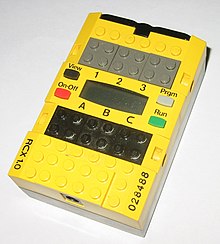
First-generation RCX programmable brick
The RCX is based on the 8-bit Renesas H8/300 microcontroller, including 32 KB of ROM for low-level IO functions, along with 32 KB of RAM to store high-level firmware and user programs. The RCX is programmed by uploading a program using a dedicated infrared interface. Afterward the user uploads a program, the RCX can run it on its own without the need for reckoner access. Programs may brand utilize of iii sensor input ports and iii ix V output ports, in addition to the IR interface, enabling several RCX bricks to communicate. A congenital-in LCD can brandish the battery level, the status of the input/output ports, which programme is selected or running, and other information.[13]
Version one.0 RCX bricks characteristic a power adapter jack in improver to batteries. In version 2.0 (likewise every bit later i.0s included in the RIS 1.5), the power adapter jack was removed. Ability adapter-equipped RCX bricks were popular for stationary robotics projects (such as robot arms) or for controlling Lego model trains. In the latter context, the RCX might be programmed with Digital Command Command (DCC) software to operate multiple wired trains.
The IR interface on the RCX is able to communicate with Spybots, Scout Bricks, Lego Trains, and the NXT (using a third-party infrared link sensor). The RCX 1.0 IR receiver carrier frequency is 38.5 kHz, while the RCX 2.0 IR carrier frequency is 76 kHz. Both versions can transmit on either frequency. The RCX communicates with a estimator using a Serial or USB IR tower. As the RCX is discontinued, support for the interface is limited on more recent operating systems than Windows XP.
All RCX versions have a unique number printed on them, which could be registered on the at present-defunct Lego Mindstorms RCX website. This was necessary to obtain technical support. The first RCX produced is marked "000001," and was on brandish at the Mindstorms 10th Anniversary event.[xiv]
The Lego RCX was available in new sets from 1998 (Lego Set up 9719: Robotics Invention System i.0) through 2003 (Lego Set 9786: Robo Technology Gear up, with USB cable). The original RCX ane.0 worked with existing Lego power supply products from the Lego Railroad train theme, Lego Product 70931: Electrical Train Speed Regulator 9V Ability Adaptor for 120v lx Hz - US version (Years: 1991 thru 2004), Lego Product 70938: Electric Train Speed Regulator 9V Ability Adaptor for 230v l Hz - European version (Years: 1991 thru 1996). Both of these products converted wall power to 12VAC, through a coaxial power connector (as well called a "butt connector"), 5.five mm outside, 2.1 mm inside. These were sometimes sold alone and sometimes available as part of other sets such as Lego Prepare 4563: Load N' Booty Railroad (Year: 1991) and Lego Set 10132: Motorized Hogwarts Limited (Yr: 2004).[15] [16] [17] [eighteen] [19] [twenty]
Lego Mindstorms NXT [edit]

Robot built from the NXT kit
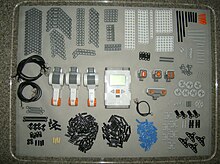
Lego Mindstorms NXT was a programmable robotics kit released by Lego in Baronial 2006, replacing the first-generation LEGO Mindstorms kit.[21] The kit consists of 577 pieces, including: 3 servo motors, 4 sensors (ultrasonic, audio, touch, and low-cal), seven connection cables, a USB interface cablevision, and the NXT Intelligent Brick. The Intelligent Brick is the "brain" of a Mindstorms machine. It lets the robot autonomously perform different operations. The kit also includes NXT-G, a graphical programming environs that enables the cosmos and downloading of programs to the NXT. The software as well has instructions for 4 robots: Alpha-Rex (a humanoid), Tri-Bot (a car), Robo-Arm T-56 (a robotic arm), and Spike (a scorpion)
Lego Mindstorms NXT 2.0 [edit]
The Lego Mindstorms NXT ii.0 was launched on 5 Baronial 2009. It contains 619 pieces (includes sensors and motors), two Touch Sensors, an Ultrasonic Sensor, and introduced a new Color Sensor. The NXT ii.0 uses Floating Betoken operations whereas earlier versions utilize Integer functioning.[22] The kit costs around US$280.
Lego Mindstorms EV3 [edit]

Brick of Lego Mindstorms EV3
The Lego Mindstorms EV3 is the third generation Lego Mindstorms production. EV3 is a further evolution of the NXT.[23] [24] The system was released on ane September 2013. The LEGO MINDSTORMS EV3 ready includes motors (2 big servo motor and 1 medium servo motor), sensors (2 bear upon sensors, ultrasonic sensor, color sensor, infrared sensor, and the new gyro sensor) , the EV3 programmable brick, 550+ LEGO Technic elements and a remote control (the Infrared Beacon, which is only on Abode/Retail mode). The EV3 can be controlled past smart-devices. It can boot an alternative operating system from a microSD card, which makes it possible to run ev3dev, a Debian-based operating organisation.
Lego Education Spike Prime number [edit]
Spike Prime was announced in April 2019.[25] While non existence function of the Mindstorms production line, the bones set includes 3 motors (one large two medium) and sensors for distance, force and color[26] a controller brick based on an STM32F413 microcontroller[27] and 520+ LEGO Technic elements.[28]
Lego Mindstorms Robot Inventor [edit]
Lego Mindstorms Robot Inventor was announced in June 2020[29] and released later in autumn. Information technology has four medium motors from Fasten Prime number, ii sensors (distance sensor and color/light sensor) too from Spike Prime number, a Spike Prime hub with a six-axis gyroscope, an accelerometer, and support for controllers and telephone command. It also has 902+ LEGO Technic elements.
Programming languages [edit]
| Name | Device | Program Type | Language blazon(s) | Notes | Links | |||
|---|---|---|---|---|---|---|---|---|
| RCX | NXT | EV3 | Runs On Brick | Remote Command | ||||
| Histrion-Lab | Custom flowchart-similar language | |||||||
| Ada | Yes | Ada | Requires nxtOSEK | |||||
| Ada Interface to MindStorms | Ada | |||||||
| App Inventor | Yep | App Inventor | Specific support for LEGO(tm) MINDSTORMS(tm) NXT sensors and motors | |||||
| brickOS | Yes | No | No | C/C++ | website | |||
| Ch | C/C++ Interpreter | Control Lego Mindstorms in C/C++ interactively without compilation | ||||||
| clang | C, C++ | |||||||
| CoderZ | Yes | Yeah | No | Coffee | Works with Blockly or with Java (using LejOS). Also includes an online 3D simulator[30] | website | ||
| Cpp4Robots | No | No | Yes | Yes | C/C++ | Cpp4Robots is extension(plugin) for Microsoft Visual Studio surround. This extension allows programming of Lego EV3 in native C/C++ language and in Microsoft Visual Studio development environs. This Cpp4Robots extension works with default firmware in EV3 Brick. | website | |
| DialogOS | Graphical Flowchart for vocalisation controlled robots | DialogOS combines spoken communication recognition and voice communication synthesis with robotics, enabling you lot to build talking robots that react to your vocalism commands. | ||||||
| Enchanting | Aye | Drag and drop, like to NXT-M | Program your robots simply by dragging the line of functions. | |||||
| EV3Basic | No | No | Yep | Yep | Yes | Microsoft Small Basic | website | |
| ev3_scratch | Yes | No | Aye | Scratch (programming language) | Scratch code runs in the browser relaying commands to EV3 robot over Bluetooth. | |||
| FLL NXT Navigation | Yes | Uses NXT-Thousand and .txt files | ||||||
| GCC | C/C++, Objective-C, Fortran, Java, Ada, others | |||||||
| Gnikrap | No | No | Yes | Aye | Aye | JavaScript / Scratch like programming | website | |
| GNU Toolchain for h8300 | C/C++, ASM | |||||||
| HVM | Yes | Development environment for the Coffee programming language for the Mindstorms EV3, Eclipse-based | Works with Coffee 1.7. Works with the standard Lego firmware. Does not require a microSD bill of fare. Requires a wireless bluetooth dongle for the EV3 | website | ||||
| Interactive C | C-style language. | Language developed for the MIT Lego Robot Design Contest | ||||||
| jaraco.nxt | Aye | Aye | Python | Python modules providing low-level interfaces for controlling a Lego NXT brick via Bluetooth. Besides includes code for controlling motors with an Xbox 360 controller using pyglet. | ||||
| LabVIEW | Yes | Yeah | Yeah | Yep | National Instruments LabVIEW visual programming linguistic communication (One thousand code) | Core language used to develop Mindstorms NXT software. Tin use available add-on kit to create and download programs to NXT, create original NXT blocks or control robot straight via USB or Bluetooth using NXT fantom.dll | ||
| LEGO MINDSTORMS EV3 API for .Cyberspace | No | No | Yes | No | Yes | .Internet, WinJS and C++ | A .Cyberspace API for the LEGO MINDSTORMS EV3 brick usable from desktop, Windows Phone and WinRT. With this API, you can connect, command and read sensor data from your LEGO EV3 brick over Bluetooth, WiFi, or USB. | website |
| Lego.Net | Anything that can compile to CIL, works all-time with C# | Does non come with a compiler, converts CIL to machine code | ||||||
| Lego::NXT | Yes | No | Yep | Perl | Gear up of Perl modules providing real-time low-level control of a Lego NXT brick over Bluetooth. | |||
| LegoLog | Prolog | Uses an NQC program to translate commands ship from the PC running the Prolog code | ||||||
| LegoNXTRemote | Yes | No | Aye | Objective-C | Remote control program for remotely operating and programming a Lego NXT Brick. Supports NXT 2.0 and 1.0, sensors, all 3 motors, automatic "steering" control, and running preloaded programs. | |||
| leJOS | Yeah | Yes | Yes | Yep | Yes | Java | A java based arrangement for advanced programmers can handle near sensors and things like GPS, speech communication recognition and mapping technology. Tin be interfaced with the Eclipse IDE or run from the command line | |
| Lestat | C++ | Allows you lot to command the NXT directly from any C++ program in Linux. | ||||||
| librcx | C/C++ | A library for GCC | ||||||
| Logitech SDK | Visual Basic, Visual C++ | Can be combined with an RCX command library such every bit spirit.ocx from the MindStorms SDK to make use of the Lego Cam | ||||||
| Microsoft Visual Programming Language (VPL) | Yes | No | Yes | Graphical flowchart, based on .Cyberspace | With the Microsoft Robotics Studio, it uses a native NXT program msrs to send and receive messages to and from a controlling plan on a computer via Bluetooth | |||
| Mindstorms SDK | Visual Basic, Visual C++, MindScript, LASM | You practise not need VB to use the VB features every bit MS Office comes with a cut down version of VB for making macros | ||||||
| Monobrick | Aye | Yes | Aye | C# | .Net 4.5. Firmware running from SD card. | website | ||
| NQC | Yep | Yes | NQC, a C-similar language | |||||
| NXT++ | C++ | Allows controlling the NXT straight from any C++ program, in Visual Studio, Windows. | ||||||
| NXT_Python | Aye | No | Yeah | Python | NXT_Python is a packet for decision-making a LEGO NXT robot using the Python linguistic communication. It tin communicate via USB or Bluetooth. | |||
| NXT-Python | Aye | No | Yes | Python | Based on NXT_Python, includes additional avant-garde features, support for around 30 sensors, and multiple brick connection backends. Works on Windows, Linux, Mac. | |||
| NXTGCC | Associates, C, makefiles, Eclipse, etc. | The first GCC toolchain for programming the Lego Mindstorms NXT firmware. | ||||||
| nxtOSEK | C/C++ | |||||||
| OCaml-mindstorm | OCaml | Module to control LEGO NXT robots using OCaml through the Bluetooth and USB interfaces. | ||||||
| OnScreen | A custom language which can be programmed directly on the RCX | |||||||
| pbForth | Yes | Forth | No longer adult. | |||||
| pbLua | Yep | API for the Lua programming language for the Mindstorms NXT, text-based | pBLua: ... is written in portable C, with minimal runtime requirements; can be compiled on the wing on NXT; is a small, piece of cake to read, and easy to write language; has extensive documentation available online and in dead-tree format, and a very friendly newsgroup | website | ||||
| PBrickDev | PBrickDev, a flowchart based language. | Has more functionality than the RIS language, such as datalogs and subroutines/multithreading. | ||||||
| PRO-BOT | A kind of Visual Basic/spirit.ocx-based linguistic communication | Designed for robots which are in contact with the workstation at all times | ||||||
| Processing | Aye | Java (Simplified / programmed C-style) | Processing (programming language) is an open source programming language and surroundings for people who want to program images, animation, and interactions. Information technology is used by students, artists, designers, researchers, and hobbyists for learning, prototyping, and production. To command the NXT with Processing yous can utilise the NXTComm Processing library adult by Jorge Cardoso. | |||||
| QuiteC | C | A library for use with GCC and comes with GCC for Windows. | ||||||
| RCX Code | Yes | RCX Lawmaking, a custom flowchart-based language | Included in the Mindstorms consumer version sold at toystore | |||||
| ROBOLAB | Yes | A flowchart language based on LabVIEW | This is the programming environment offered to schools who use MindStorms, supports the Lego Cam. The programming structure simulates a flowchart pattern structure nearly icon by icon. Therefore, it helps users a great bargain in terms of translating from a flowchart blueprint to Robolab icons. | |||||
| RoboMind | Elementary educational scripting language available from Arabic to Ukrainian. | The RoboMind learning environment allows to apace develop and examination scripts for a virtual robot environment. The scripts can then directly exist transferred to a Lego Mindstorms NXT robot. It works on the standard firmware. | ||||||
| RoboRealm | A multi-platform linguistic communication that works with IRobot Roomba, NXT, RCX, VEX, and many other popular robotic sets. This linguistic communication is also capable for video processing using a webcam, this gives your robot first-class vision since it can filter out certain colors, lock-on to a certain area of color, display variables from the robot or computer, and much more than. The software works with keyboard, joystick, and mouse. | |||||||
| Robot JavaScript | No | Aye | Yes | Yes | JavaScript | A compiler that compiles JavaScript code for EV3 robots. Includes syntax highlighting, lawmaking sharing, over 100 instance programs, and verbose compiler messages. Object oriented language. Free. | website | |
| ROBOTC | Yep | Yes | Yes | Yes | An Integrated development environment targeted towards students that is used to program and control LEGO NXT, VEX, RCX and Arduino robots using a programming language based on the C programming language. | ROBOTC gives the ability to employ a text-based language based on the C linguistic communication. It includes built-in debugger tools, too as (only not limited to) code templates, Math/Trig operations (sin, cos, tan, asin, acos... etc.), user-friendly auto-complete function built into the interface, built-in sample programs. This deserves a special notation for its debugging tool. For any programmer, you will know how important it is to take a skilful debugging tool. Among all other robotics programming languages which support Mindstorms platform, RobotC's debugging environment does deserve a special notation; although information technology is non free. | ||
| Robotics.NXT | Yep | Yes | Haskell | A Haskell interface over Bluetooth. It supports straight commands, letters and many sensors (too unofficial). It has also back up for a simple bulletin-based command of a NXT brick via remotely executed program (bones NXC lawmaking included). | ||||
| ROS | A Linux based library for writing robots. The stack "nxt" provides interface with the NXT. | |||||||
| ruby-nxt | Yes | Yes | Carmine | Provides depression-level access to the NXT via Bluetooth as well every bit some preliminary high-level functionality. | ||||
| RWTH – Mindstorms NXT Toolbox | Aye | Yes | MATLAB | Interface to control the NXT from MATLAB via Bluetooth or USB (open up-source). | ||||
| Simulink (LEGO MINDSTORMS NXT Support) | Yes | Simulink | Provides a 1-click rapid programming tool for the NXT. C code is automatically generated from a graphical Simulink model. The lawmaking is and then deployed and downloaded onto the NXT, from where it tin be run. The Mathworks provides an array of graphical blocks that represent the various sensors and actuators that the NXT uses. | |||||
| SqLego | Squeak | |||||||
| Swift / Robotary | Yes | Yes | Swift (programming language) | Robotary is a Mac robotics studio that uses the Swift programming language. | website | |||
| TclRCX | Yes | Tcl | ||||||
| Terrapin Logo | LOGO | |||||||
| TinySoar | Soar | An implementation of the Soar artificial intelligence architecture that runs on the RCX brick. Soar incorporates acting, planning, and learning in a dominion-based framework. | ||||||
| TinyVM | Aye | Java | A predecessor to the lejos language. An open source Java based replacement firmware for the Lego Mindstorms RCX microcontroller. | |||||
| Transterpreter (The) | Occam | |||||||
| TuxMinds | (Linux) GUI for various distributions, an open source IDE based on Qt. Supports a lot of bots. RCX, NXT and Asuro are predefined. | With the XML-based configuration file nearly any kind of bot (or microcontroller) tin can exist added. Own equipment tin be added in the same fashion. | ||||||
| URBI by Gostai for Lego Mindstorms NXT | URBI, C++, Java, Matlab | Piece of cake to use parallel and issue-driven script language with a component architecture and opensource interfaces to many programming languages. Information technology also offers vocalisation/speech recognition/synthesis, face recognition/detection, Simultaneous localization and mapping, etc. | ||||||
| Vision Command | Yep | RCX Code | The official programming linguistic communication for use with the Lego Cam, that allows y'all to control your robot with color, movement, and flashes of light. | |||||
| XS | Lisp | |||||||
Use in education [edit]
Mindstorms kits are also sold and used every bit an educational tool, originally through a partnership between Lego and the MIT Media Laboratory.[31] [32] The educational version of the products is called Mindstorms for Schools or Mindstorms Education, and later versions come up with the ROBOLAB GUI-based programming software, developed at Tufts Academy[33] using the National Instruments LabVIEW as an engine.
Meet also [edit]
- Beginning Lego League
- WRO (Earth Robot Olympiad)
- Robofest
- Outset Tech Challenge
- RoboCup Junior
- WeDo two.0
- Big Trak
- iRobot Create
- Robotis Bioloid
- The Robotic Workshop
- Robotics suite
- C-Stem Studio
- Botball
References [edit]
- ^ a b c d east f g h i Beland, Cristopher (xv December 2000). LEGO Mindstorms: The Structure of an Engineering (R)evolution (conference paper). Docket 6.399J Structure of Applied science Revolutions. Archived from the original on 27 January 2021. Retrieved 25 March 2019.
- ^ a b Papert, Seymour (1993) [1980]. Mindstorms: Children, Computers, and Powerful Ideas. New York: Basic Books. ISBN978-0-465-04674-iv.
- ^ a b c d "To Mindstorms and Beyond: Evolution of a Construction Kit for Magical Machines" (PDF). MIT Media Laboratory. Archived (PDF) from the original on 22 Baronial 2017. Retrieved 15 December 2017.
- ^ a b c Resnick, Mitchel; Ocko, Stephen (1 January 1991). "LEGO/Logo: Learning through and almost design". MIT Media Lab (Thesis). Massachusetts Plant of Technology (MIT). Retrieved thirteen Baronial 2021.
- ^ a b c d e Martin, Fred (Baronial 1988). "Children, Cybernetics, and Programmable Turtles" (PDF) (Thesis). Massachusetts Institute of Engineering (MIT). Retrieved 13 August 2021.
- ^ a b c d Askildsen, Tormod (4 December 2018). "LEGO Mindstorms reflections – What happened earlier the announcement in January 1998". lan.Lego.com. The LEGO Grouping. Archived from the original on 26 March 2019. Retrieved 26 March 2019.
- ^ a b c d Oliver, David; Roos, Johnathan (2003). "Dealing with the unexpected: Critical incidents in the LEGO Mindstorms team". Human Relations. 56 (9): 1057–1082. doi:10.1177/0018726703569002. S2CID 145417935. Archived from the original on 27 January 2021. Retrieved 26 March 2019.
- ^ Hocker, Matt (3 February 2020). "A History of LEGO Educational activity, Office 3: Mindstorms over thing [Feature]". The Brothers Brick . Retrieved 15 August 2021.
- ^ "Retailers Brace for Overwhelming Consumer Demand for LEGO MINDSTORMS Robotics Invention System" (Printing release). Enfield, CT: The Lego Group. 26 August 1998. Archived from the original on half dozen December 1998. Retrieved 3 July 2022.
"LEGO MINDSTORMS announced today that the very get-go units...will arrive...during the first calendar week of September." - ^ The verbal number of sets in the commencement product run varies between sources
- ^ a b Robertson, David (2013). Brick by Brick: How Lego rewrote the rules of innovation and conquered the global toy manufacture. The states: Crown Publishing. pp. 184–185. ISBN9780307951618. Archived from the original on 29 November 2020. Retrieved 27 January 2021.
- ^ "ROBOTICS DISCOVERY SET - INFO FOR HACKERS". 10 February 2001. Archived from the original on 10 February 2001.
- ^ Kekoa Proudfoot (1999). "RCX Internals". mralligator.com. Archived from the original on eleven November 2018. Retrieved 14 Dec 2018.
- ^ "DSC03489.jpg". flickr.com. twenty November 2008. Archived from the original on 17 November 2016. Retrieved four April 2018.
- ^ "Peeron LEGO© Inventories - Lego Product 70931: Electric Train Speed Regulator 9V Ability Adaptor for 120v 60Hz - United states version (Years: 1991 thru 2004)". peeron.com. Peeron LEGO© Inventories. Retrieved 10 October 2021.
- ^ "Peeron LEGO© Inventories - Lego Production 70938: Electric Railroad train Speed Regulator 9V Ability Adaptor for 230v 50Hz - European version (Years: 1991 thru 1996)". peeron.com. Peeron LEGO© Inventories. Retrieved x October 2021.
- ^ "Peeron LEGO© Inventories - Lego Production 884: Electric Mindstorms RCX - Consummate Assembly (Years: 1998 thru 2003)". peeron.com. Peeron LEGO© Inventories. Retrieved 10 October 2021.
- ^ "Lego RCX presentation - Clark Wood - BrickCon 2013". cementhorizon.com. BrickCon. Retrieved 10 Oct 2021.
- ^ "FIRST® LEGO® League Programming and Pattern Suggestions - Power". boardsailor.com. The Los Altos Robotics Community. Retrieved 10 October 2021.
- ^ "LEGO® MINDSTORMS™ Internals". crynwr.com. Crynwr Software. Retrieved x October 2021.
- ^ "What's NXT? LEGO Group Unveils LEGO MINDSTORMS NXT Robotics Toolset at Consumer Electronics Show". Printing Release. LAS VEGAS: LEGO Company. 4 January 1986. Archived from the original on eight July 2009. Retrieved three December 2008.
- ^ "Lego Robotics FAQ". 2009. Archived from the original on 8 Baronial 2010. Retrieved 2 March 2010.
- ^ "EV3-Overview". Archived from the original on 24 June 2013.
- ^ Crook, Jordan. "LEGO Mindstorms EV3: The Better, Faster, Stronger Generation of Robotic Programming". TechCrunch. Archived from the original on 23 Oct 2017. Retrieved 22 May 2015.
- ^ "A new hands-on learning approach for classrooms, appear today". www.lego.com. Archived from the original on 10 Baronial 2020. Retrieved 8 January 2021.
- ^ "LEGO® Teaching SPIKE™ Prime Ready 45678 | LEGO® Education | Buy online at the Official LEGO® Shop U.s.". www.lego.com. Archived from the original on 3 December 2020. Retrieved 8 Jan 2021.
- ^ "gpdaniels/fasten-prime number". 25 Jan 2021. Archived from the original on 25 Dec 2020. Retrieved 8 Jan 2021 – via GitHub.
- ^ Porter, Jon (15 June 2020). "Lego's new Mindstorms kit lets kids build their own walking, talking robots". The Verge . Retrieved seven September 2021.
- ^ "New LEGO® MINDSTORMS® Robot Inventor lets creators build and bring to life anything they tin imagine". www.lego.com. Archived from the original on fifteen January 2021. Retrieved 8 January 2021.
- ^ "CoderZ, an online learning environment for MINDSTORMS robotics". www.thenxtstep.com. Archived from the original on fourteen June 2017. Retrieved 30 May 2017.
- ^ "The MIT Programmable Brick". Epistemology and Learning Grouping. Massachusetts Institute of Technology. 13 February 1998. Archived from the original on 25 October 2005. Retrieved i Oct 2013.
- ^ "Programmable Bricks". Projects. MIT Media Lab. Archived from the original on 21 Oct 2013. Retrieved iii December 2008.
- ^ Erwin, Ben; Cyr, Martha; Rogers, Chris (2000). "LEGO Engineer and RoboLab: Teaching Engineering with LabVIEW from Kindergarten to Graduate School" (PDF). International Journal of Technology Didactics. 16 (3): 181–192. Archived (PDF) from the original on 23 September 2013. Retrieved ane October 2013.
For the past vi years, kinesthesia members at Tufts University have developed 2 different software packages between LabVIEW and Lego data conquering systems. These packages allow united states to teach engineering with both Lego bricks and LabVIEW to students from five to 50 years old. The versatility of the hardware and software allow a wide variety of possibilities in what students can build and program, from robots and remote sensing devices to kinetic sculptures. As students design and build their projects, they are motivated to learn the math and science needed to optimize their projection. Both college students and kindergartners respond to this motivator. In the newspaper, we explicate how we designed software to complement these projects in allowing automation and animation. The software uses LabVIEW, extending its capabilities to kindergartners and Lego bricks. Finally, nosotros volition show how we have used LabVIEW and Lego data conquering to teach elementary school science, freshman technology, instrumentation and experimentation, and how college seniors and graduate students have used both the hardware and software to solve various information acquisition problems
Further reading [edit]
- Bagnall, Brian. Maximum LEGO NXT: Edifice Robots with Java Brains. Variant Printing. 2007. ISBN 0-9738649-1-5.
- Bagnall, Brian. Core LEGO Mindstorms. Prentice-Hall PTR. 2002. ISBN 0-13-009364-5.
- Baum, Dave. Definitive Guide to LEGO MINDSTORMS, 2nd ed. Apress. 2002. ISBN i-59059-063-5.
- Erwin, Benjamin. Creative Projects with LEGO Mindstorms (volume and CD-ROM). Addison-Wesley. 2001. ISBN 0-201-70895-seven.
- Ferrari et al. Building Robots with LEGO Mindstorms: The Ultimate Tool for Mindstorms Maniacs. Syngress. 2001. ISBN ane-928994-67-ix.
- Gindling, J., A. Ioannidou, J. Loh, O. Lokkebo, and A. Repenning., "LEGOsheets: A Rule-Based Programming, Simulation and Manipulation Environment for the LEGO Programmable Brick", Proceeding of Visual Languages, Darmstadt, Germany, IEEE Computer Social club Press, 1995, pp. 172–179.
- Breña Moral, Juan Antonio. Develop LeJOS programs Step by Step.
External links [edit]
- Official LEGO Mindstorms
- Lego Mindstorms at Curlie
Source: https://en.wikipedia.org/wiki/Lego_Mindstorms
Posted by: dillplarecturs.blogspot.com
0 Response to "Lego Com Mindstorms Software Mission 01"
Post a Comment